Evgeny Merman: NoWomenNoKids/DeadSeaNotDead
 Sooner or later, the body returns. Not as abstraction, not as symbol, but as presence. As history. As resistance.
28.08.2025.
In the work of artist Evgeny Merman, the body is a recurring site: a place where violence meets memory, and memory refuses to fade.
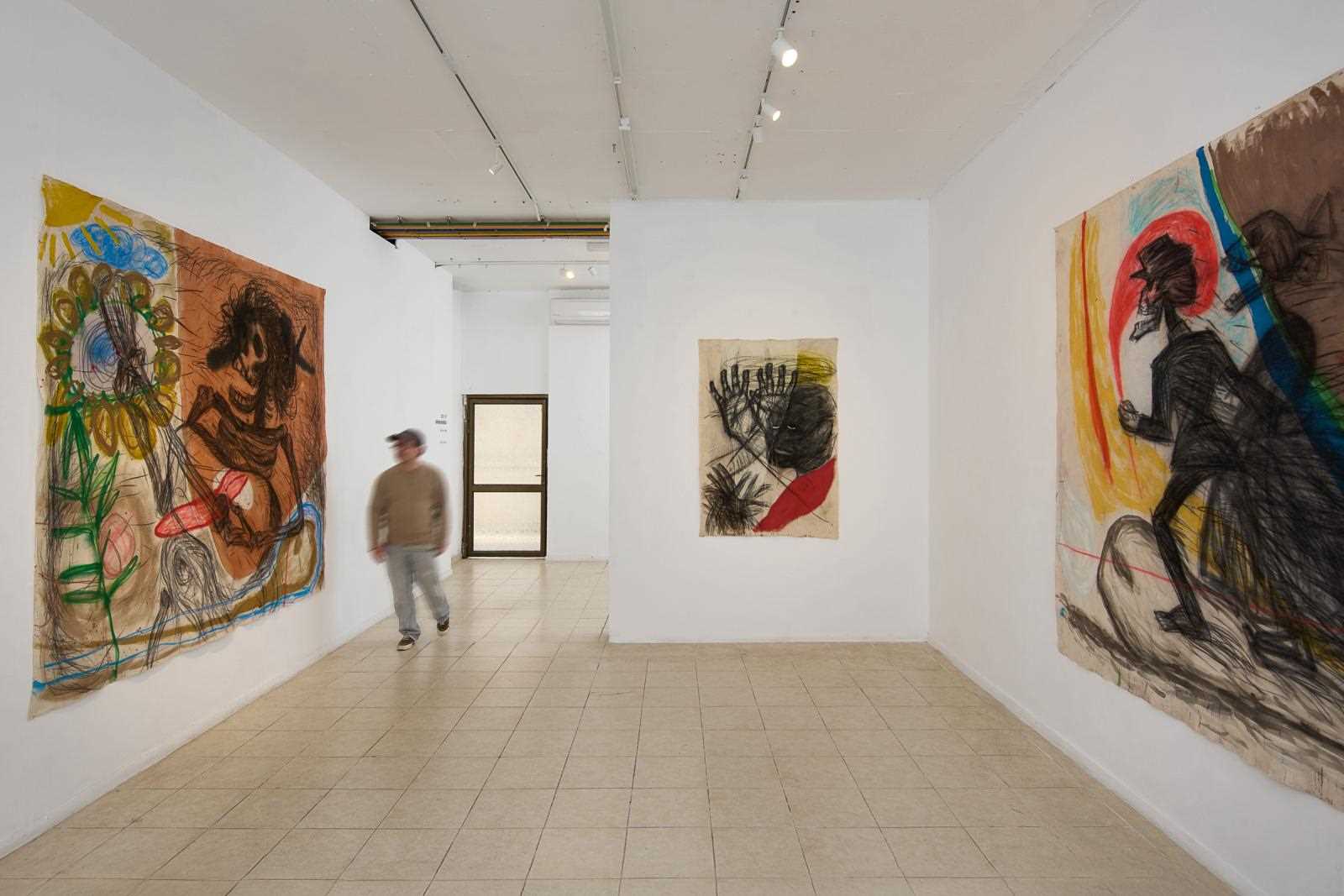
In his earlier series No Women No Kids, Merman summoned skeletal figures, half grim reaper, half folk prophet, onto raw, unframed canvases. Their style echoed the calaveras of José Guadalupe Posada, the 19th-century Mexican printmaker whose skeletons laughed and danced even as they bore the marks of death. In Western art, the skull traditionally served as a memento mori — a cold reminder of mortality. But in Aztec culture, and in Posada’s prints, the skull was not just a warning. It was a promise. A symbol of return, of regeneration.
Merman’s skeletons carry that double weight: they grieve and they grin. They evoke the danse macabre tradition of medieval Europe, where the dead and living danced together in recognition of a shared fate. But they also speak to something more contemporary: in the wake of global violence, war, and personal loss, these skeletal bodies, drawn with graffitilike urgency on scarred linen, stand for what endures. What survives. What insists on being seen.
These works are not delicate studies. They are raw transmissions, drawn with natural pigments and charcoal, often on huge, unstretched canvases. The mark-making is impulsive yet deliberate, coming not from stylization, but from the artist’s own anatomy: brain, heart, hand. The line, erratic and unfiltered, becomes a metaphor for puberty, for the first collision of internal turbulence and outward form. The skeletons, then, are not just figures. They are thresholds. They mark the passage from one state of being to another.
That same urgency pulses through Merman’s series of large-scale paintings created by the Dead Sea. But the mood has shifted. The bones have been replaced by skin. Women’s bodies — nude, open, unflinching, stretch across the salt-bleached canvas. They do not perform. They do not apologize. They lie down along the horizon as if claiming it. Here, the body is not skeletal but fully alive: though the place it occupies is famously lifeless. The Dead Sea: biblical, mineral-rich, inhospitable. A body of water that does not support life. And yet, here are these women. Breathing. Being. Refusing to vanish.
The contrast between the two series: one skeletal, the other embodied, reveals a continuum in Merman’s work. He is not staging a reversal, but a return. Both series confront mortality, but from opposite ends. No Women No Kids tears away the flesh to reveal the bones; the DeadSeaNotDead works offer the body back, unapologetically whole. Both ask: What is left after survival? What does it mean to take up space after violence?
And always, there is the line. The drawn line, yes, but also the moral line. The title No Women No Kids, borrowed from Luc Besson’s Léon: The Professional, refers to the hitman’s one rule. A line of mercy amid brutality. But the rule is broken, as all rules are. The body becomes collateral. And in Merman’s hands, it also becomes witness. Between the lines drawn across canvas, across history, and across skin, a quiet reawakening occurs. The skeletons laughed in the face of death; the women rest in the presence of it. Neither looks away. Because even beside a sea that no longer sustains life, the body endures. And in its stillness, it begins again.


CV
Evgeny Merman
Evgeny Merman is a multimedia artist and curator, born in Kyiv, Ukraine. He currently lives and works in Tel Aviv. After completing his studies at the School of Visual Arts in New York and spending several years in New York and Hong Kong, he relocated to Israel, where he has continued to develop his artistic career.
Merman has presented solo exhibitions in Tel Aviv, Jerusalem, and Kyiv, as well as at MuseumLV in Riga and at the Museum and Center of Contemporary Art in Ticino, Switzerland. In 2019, he was awarded First Prize at the 33rd Kyoto Art Biennale, an international juried exhibition in Japan.